Arozarena Declines the Qualifying Offer: Would You Give Up a Draft Pick to Bring Him to Houston?
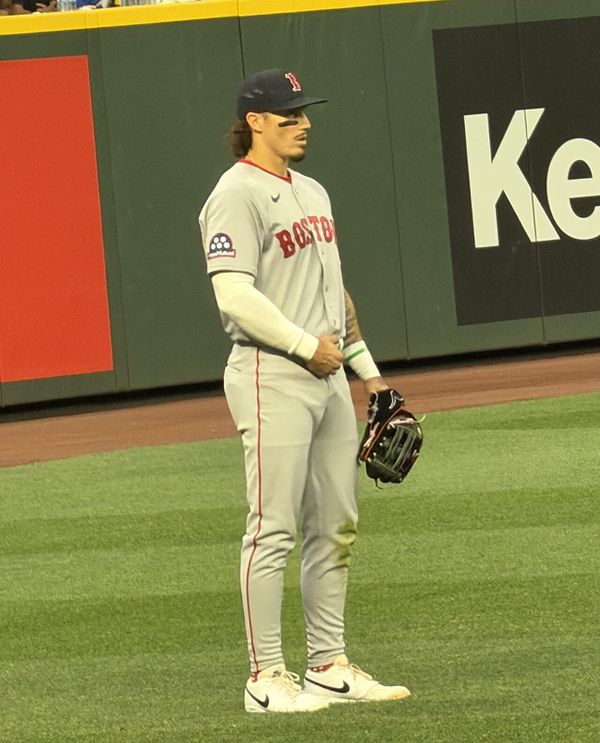
Randy Arozarena turned down Seattle's $23.15M qualifying offer, and reporter Francys Romero says the Astros are among the teams monitoring his market. Here is what signing him would cost Houston in draft picks, and whether it is worth it.
Randy Arozarena turned down the Seattle Mariners' qualifying offer on Tuesday, and on Wednesday afternoon Francys Romero, a BBWAA baseball reporter, posted that teams such as the Phillies, Yankees, Orioles, Blue Jays, Astros and Padres are "among those monitoring his market." Romero is the only source, and "monitoring" is all he said. No talks, offer or pursuit has been reported.
That sets up a question worth asking before any of it gets serious: would you give up a draft pick to sign him? First, who pays what. A team that signs Arozarena loses its own pick or picks. Seattle gets a separate compensation pick. Houston does not hand its pick to the Mariners.
Arozarena was one of five players on MLB's official list (3:14 p.m. CT Tuesday) who "declined the qualifying offer and remain free agents," along with Brandon Lowe, Adrian Morejon, Trevor Rogers and Seiya Suzuki. The offer was worth $23.15 million for 2027, per Darragh McDonald of MLB Trade Rumors, who credited Alden Gonzalez of ESPN for the decisions. Seattle Sports had first passed along the news on Monday, via a post from Romero.
Get Astros offseason news free. Join the Crawford Box Report newsletter.
Free, no spam. Or subscribe here.
What Houston would give up
Under the current labor deal, the cost depends on the signing team's financial status. According to MLB Trade Rumors and MLB.com's explainer:
- Clubs that neither pay the competitive balance tax nor receive revenue sharing: lose their second-highest 2027 draft pick and $500,000 from their international bonus pool.
- Tax payors: lose their second- and fifth-highest picks and $1 million of international pool money.
- Revenue-sharing recipients: lose their third-highest pick.
A team's top first-round pick is protected. MLBTR lists the Astros in the middle group, with the Angels, Giants, Nationals, Rangers and White Sox. That placement rests on estimates. Spotrac puts Houston's 2026 tax payroll at about $234.9 million and FanGraphs' RosterResource at about $235.9 million, both under the $244 million threshold. MLB's official calculations don't come until early December. If they put Houston over the line, the higher penalty would apply.
Houston has not signed a qualified free agent this winter and did not extend a qualifying offer of its own, so no other pick is currently at stake.
Seattle's side is separate. If Arozarena signs elsewhere for $50 million or more, the Mariners get a pick between the first round and Competitive Balance Round A. Under $50 million, it comes after Round B. MLBTR projects four years and $100 million for Arozarena, and MLB.com's Daniel Kramer wrote that most in the industry expect $100 million to $150 million.
One caveat: the collective bargaining agreement expires Dec. 1, and a lockout is expected right after. MLB's own proposals include eliminating the qualifying offer system. Whatever deal comes next could change these rules, and a signing that waits past the lockout could carry a different price.
The case for
Arozarena hit .281/.381/.484 with 26 home runs and 26 steals in 154 games, led the American League with 113 runs scored and won a Silver Slugger, the Seattle Times' Ryan Divish reported. MLB.com's free-agent tracker has him at 5.5 fWAR and a 148 OPS+, fifth among qualifiers.
Houston needs outfield bats. MLBTR's offseason outlook says the outfield "has been lacking for the past two seasons." Jake Meyers, Daulton Varsho and LaMonte Wade Jr. are free agents. Cam Smith hit .210/.279/.390 with an 87 OPS+ in right field, and Joey Loperfido was outrighted to Triple-A after hip surgery. Yordan Alvarez, at .316/.432/.601, is a designated hitter, not a fix in the grass.
The case against
Arozarena is 31, and a long deal would carry him well into his mid-30s. Kramer noted his Statcast defensive marks were poor: 12th percentile in fielding run value and sixth percentile in arm value. The same piece said Seattle plans to upgrade defense in left field.
There is also the money question. MLB.com's Hot Stove roundup points out that Houston's rotation ranked 27th in ERA (4.81) in 2026. Jon Paul Morosi of MLB Network said Wednesday that the Astros "could afford a [Trevor] Rogers or a Clay Holmes" if they can finalize a trade involving Christian Walker. That is Morosi's read on what Houston could afford, not a report of interest in either pitcher. A $25 million-a-year outfielder and a rotation upgrade may not both fit.
Our take
This is our opinion, not reporting. The pick is the smaller cost. The second-highest pick and $500,000 in international pool money are real, but the Astros' farm system is not deep, and the contract is the bigger commitment. We would pay the pick for a bat like this, as long as the price does not crowd out pitching. At $100 million over four years, we would want a clear plan for the rotation before signing.
Your turn
Would you give up a pick to sign him? Let us know.
Get Astros offseason news free. Join the Crawford Box Report newsletter.
Free, no spam. Or subscribe here.
Subscribe free at crawfordboxreport.com.